



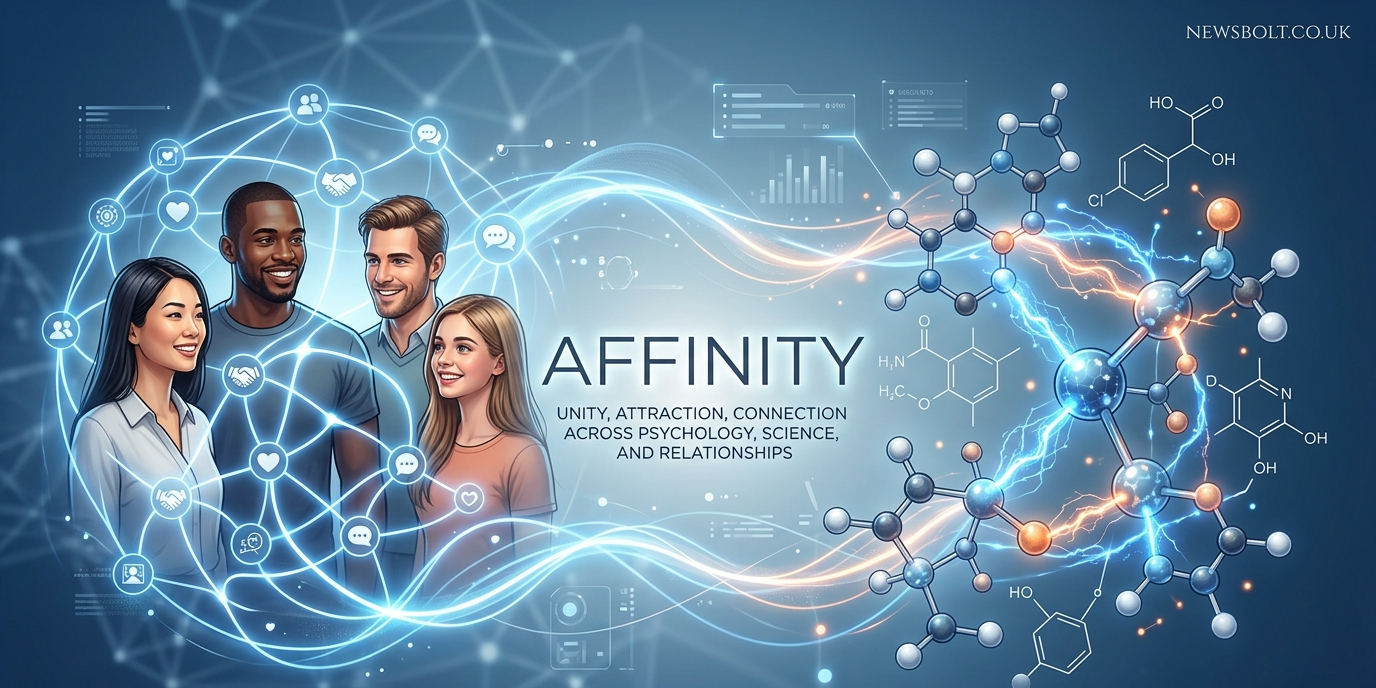
Affinity Definition is a widely used concept that appears in language, psychology, science, marketing, and social relationships. At its core, affinity refers to a natural connection, attraction, or similarity between people, ideas, or things. It explains why individuals feel drawn to certain people, why molecules bind together in chemistry, and why consumers prefer specific brands over others.Affinity Definition
In modern usage, affinity is not just about liking something. It also describes deeper emotional, structural, or functional connections that develop naturally without force. According to dictionary definitions, affinity can mean a feeling of closeness, a natural liking, or even a measurable similarity between entities that interact with each other.Affinity Definition
This article explores affinity in detail, covering its linguistic origin, psychological importance, scientific meaning, and real-world applications in everyday life and business.
The Meaning and Core Concept of Affinity
Affinity is generally defined as a natural attraction, liking, or similarity between two or more things. It represents a bond that forms due to shared qualities, compatibility, or emotional connection. In simple terms, it explains why certain people, ideas, or objects naturally “fit” together.Affinity Definition
In human behavior, affinity is often linked with emotional comfort and familiarity. People tend to feel more connected to individuals who share similar values, interests, or experiences. This is not forced but develops naturally through interaction and recognition of similarities.
Affinity also includes the idea of structural or functional similarity. When two systems behave in a compatible way or share characteristics, they are said to have affinity. This makes the concept useful across multiple disciplines, from psychology to science.Affinity Definition
Historical Origin and Evolution of Affinity
The word affinity comes from the Latin term affinitas, which originally referred to relationships formed through marriage or legal connections rather than blood ties. Over time, its meaning expanded to include broader ideas of similarity, attraction, and connection.Affinity Definition
In early European philosophy and science, affinity was used to describe the tendency of substances or ideas to naturally combine. This concept later influenced chemistry and sociology, where researchers used it to explain bonding, interaction, and association patterns.
Today, affinity is a modern interdisciplinary term used in psychology, marketing, biology, and everyday communication. Its evolution reflects how human understanding of relationships and connections has grown more complex over time.Affinity Definition
Affinity in Psychology and Human Behavior
In psychology, affinity refers to an inherent or learned attraction toward people, ideas, or environments based on shared traits or emotional compatibility. Humans naturally seek connection, and affinity plays a central role in forming relationships.
When individuals recognize similarities in values, personality, or experiences, they experience psychological comfort. This sense of familiarity reduces uncertainty and builds trust, making relationships stronger and more stable over time.
Affinity also influences decision-making and personal preferences. People often choose friends, partners, and even lifestyles that align with their identity and beliefs. This psychological tendency explains why humans form social groups and emotional bonds so easily.
Affinity in Chemistry and Biological Sciences
In chemistry and biology, affinity refers to the strength of attraction between two substances. It is commonly used to describe how molecules, atoms, or biological structures interact with each other.
For example, in biological systems, affinity explains how strongly an antibody binds to an antigen. A higher affinity means a stronger and more effective interaction, which is essential for immune response. In pharmacology, drug affinity describes how well a drug binds to a receptor in the body, influencing its effectiveness and behavior.
Scientific definitions describe affinity as the tendency of substances to combine or interact under certain conditions.
This makes it a fundamental concept in understanding chemical reactions, biological processes, and medical treatments.
Affinity in Sociology and Social Relationships
In sociology, affinity refers to the sense of connection, similarity, or shared identity among individuals or groups. It explains how communities form based on shared interests, values, or cultural backgrounds.
People with similar beliefs or goals often come together naturally, forming what are known as affinity groups. These groups are built on trust, shared understanding, and emotional closeness, rather than formal structures.
Social affinity also plays a role in identity formation. Individuals often associate themselves with groups that reflect their personal beliefs or lifestyle. This creates a sense of belonging and strengthens social cohesion within communities.
Affinity in Business, Marketing, and Brand Loyalty
In business and marketing, affinity is a powerful concept used to describe emotional connections between consumers and brands. This is often referred to as brand affinity, which goes beyond simple customer satisfaction or repeated purchases.
Brand affinity develops when consumers feel that a brand reflects their identity, values, or lifestyle. When this emotional connection is strong, customers are more likely to remain loyal, recommend the brand, and even ignore competing offers.
Businesses actively work to build affinity through storytelling, consistent experiences, and emotional engagement. Unlike transactional relationships, brand affinity focuses on long-term trust and emotional attachment, making it a key factor in modern marketing success.
Affinity in Daily Life and Personal Preferences
Affinity is present in everyday life, often influencing choices and behaviors without us realizing it. People naturally develop affinities for certain foods, hobbies, environments, or types of personalities based on comfort and familiarity.
For example, someone may feel a strong affinity for music, sports, or travel because these activities align with their personality or past experiences. These preferences are not random; they are shaped by emotional memory and repeated exposure.
In relationships, affinity explains why some friendships feel effortless while others require more effort. The presence of shared values and mutual understanding creates natural harmony between individuals.
Scientific and Technical Applications of Affinity
Beyond psychology and marketing, affinity plays a major role in technical and scientific fields. In modern science, it is often used to describe measurable interactions between entities, especially in chemistry and pharmacology.
In chemistry, affinity describes the tendency of atoms or molecules to combine and form stable compounds. In biology, it helps explain how enzymes interact with substrates and how biological systems maintain balance.
Scientific sources define affinity as the strength of attraction between substances, such as chemicals or biological molecules.
This makes it a key concept in understanding how reactions occur and how biological systems function efficiently.
Conclusion: Why Affinity Matters in Understanding Human and Scientific Connections
Affinity is a universal concept that connects emotional, social, and scientific worlds. Whether it describes human relationships, molecular interactions, or brand loyalty, the underlying idea remains the same: natural attraction and compatibility between entities.
Understanding affinity helps explain why people form relationships, why substances react in certain ways, and why consumers prefer specific brands. It reveals the hidden connections that shape behavior, decision-making, and interaction across different systems.
In both personal and professional life, recognizing affinity allows for better communication, stronger relationships, and more meaningful connections. It is not just a definition but a fundamental principle that influences how the world interacts at both human and scientific levels.
READ MORE: NEWSBOLT
